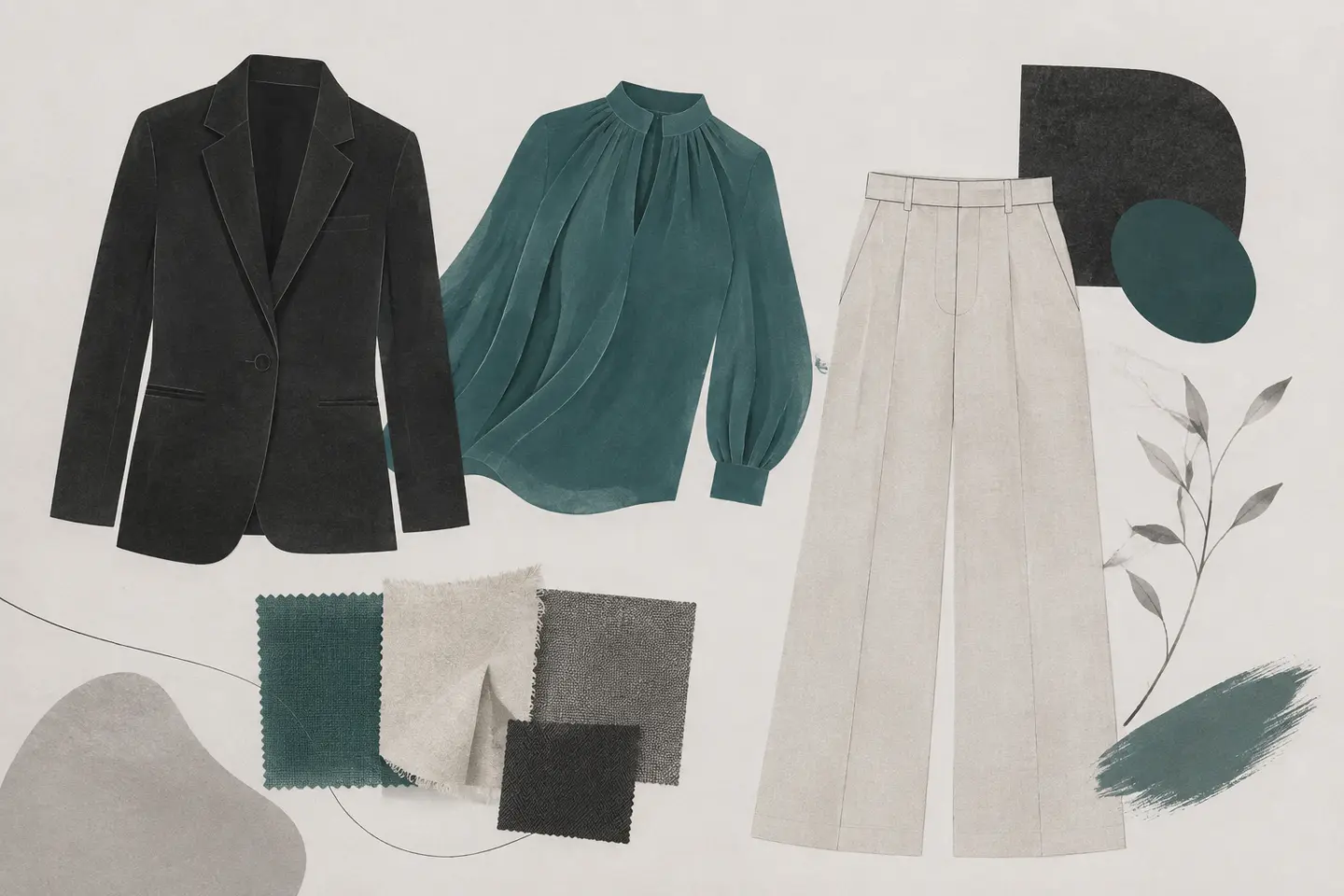
James Andean · women’s wholesale wear
Women's Wear: A Practical Guide to Choosing Clothes

By Ruth Keller
Choose clothes for the conditions in which you will wear them. Fit, fabric, construction and care help you judge whether a garment will work beyond its first fitting. Start with what you need, then test it with the pieces you already own.
What women's wear really includes
Women's wear traditionally describes clothing designed and marketed for women, but the category has never been as rigid as its labels suggest. Clothing responds to culture, work, movement, weather, ceremony and personal identity. A tailored trouser suit can borrow from menswear while still belonging fully to contemporary women's wear. A dress can be formal, practical, relaxed, architectural or deliberately ambiguous.
Clothing categories can provide a starting point without dictating what you wear. A museum exhibition guide offers historical context: Its account of women dressing women. Use such references to explore shapes and details rather than as rules for your wardrobe.
Start with purpose, not pressure
The strongest garment decisions usually begin with a clear occasion. “I need something for work” is a starting point, but it becomes more useful when translated into real conditions. Will you be sitting, walking, travelling, presenting, layering, or moving between indoor and outdoor spaces? “Something for an event” raises different questions: how formal is the setting, how long will you wear it, and do you want the garment to carry the room or quietly support you within it?
Try describing the job of a garment in one sentence: “This jacket should sharpen soft pieces.” “These trousers should work with flat shoes and a heel.” “This knit should add warmth without taking over the outfit.” That sentence becomes a better filter than a vague promise that a piece is “versatile.”
Fit is a conversation with the body
Fit is often treated as a pass-or-fail measurement, but it is more accurately a conversation between the body and the garment. A close fit may be intentional; a loose fit may be the point. The question is whether the shape looks deliberate and allows the wearer to move as intended.
Look first at the places where tension reveals itself: buttons pulling across the bust, pockets opening at the hip, a waistband cutting in when seated, or a shoulder seam falling far beyond the natural shoulder without a clear oversized design. Then look at balance. Does the length work with the volume? Does the rise of the trouser support the top? Does the sleeve finish where the rest of the outfit needs it to finish?
Size labels are only a guide. They vary between makers and across garment types, so measurements and construction deserve more trust than a number on a tag. When shopping online, compare the listed measurements with a garment you already own and like. Pay attention to whether the measurements describe the body or the finished garment. If that distinction is unclear, the result may be guesswork.
Alterations can refine a good garment, but they cannot always rescue a poor foundation. Hems, sleeves and modest waist adjustments are often straightforward. Major changes to shoulder placement, rise, armhole or overall proportion may be more complicated. Buy for the most important structural points first, then consider what can be adjusted.
Fabric changes the entire experience
Two garments can share the same cut and feel entirely different because of their fabric. Fibre content is only the beginning. Weight, weave, stretch, drape, opacity, surface texture and recovery all affect how a piece behaves.
A fluid fabric can soften a sharp silhouette. A firmer cloth can hold shape and create definition. Stretch may make a garment easier to move in, but it does not automatically make it comfortable or durable. A light fabric may be pleasant in warm weather and less useful when it needs to provide structure. Texture can add depth to a simple outfit, while a smooth surface may make tailoring feel more formal.
Read the composition label, then use your hands and eyes. Hold the garment up to the light if opacity matters. Scrunch a section gently and see how it responds. Check whether a knit springs back or remains stretched. Inspect seams, hems, fastenings and lining. A beautiful front view is not enough; construction is what the garment has to live with.
Read composition and care information together. The FTC’s apparel-labeling guidance provides background on clothing labels. For a practical purchase decision, check how the finished garment should be cleaned instead of assuming its fibre content tells you everything.
If a garment requires a method of care you will realistically avoid, it may not be the right garment for your wardrobe. The most elegant piece is not useful if it remains unworn because maintaining it feels too difficult.
Colour, proportion and the quiet work of styling
Colour is personal, but it also changes the perceived relationship between garments. A wardrobe does not need to be neutral to be coherent. It needs a few repeatable connections. Perhaps those connections come from a consistent dark base, a family of muted tones, a preference for warm colours, or a habit of pairing one vivid accent with simpler pieces.
When considering a new colour, ask what it can meet in the wardrobe you already own. If it works with several existing pieces, it has a practical role. If it only works as a complete new outfit, that may still be worthwhile—but it is a different purchase, and should be judged honestly.
Proportion is just as important as colour. A generous shirt may work with a narrow trouser, a straight skirt or a controlled short. A wide trouser can create a strong line with a fitted top, a cropped jacket or a deliberately long layer. These are not rules that must be obeyed. They are ways to see why an outfit feels balanced or why it feels visually stuck in the middle.
Accessories complete the conversation. A belt can clarify a waist or interrupt a long line. Jewellery can echo a neckline or introduce contrast. A bag changes the practical reality of the outfit. Shoes affect not only height and mood but also whether the chosen hem, volume and pace make sense together.
Women's wear should leave room for agency
Clothing can communicate identity, but it should not become a test the wearer has to pass. A useful wardrobe makes room for contradiction: softness and structure, polish and ease, convention and experimentation. It can borrow from menswear, historic dress, workwear, sportswear or subculture without needing to justify every reference.
Looking at how clothing is made can be as useful as looking at complete outfits. For further reading, a museum offers Its publication on women fashion designers. When examining a garment yourself, pay attention to pattern cutting, seams and finishing rather than relying on the story attached to it.
That perspective can sharpen the way you shop. Look beyond the surface story. Who made the garment? What information is available about its materials and construction? Is the design offering a useful point of view, or simply asking to be replaced as soon as the next image appears? There will not always be a complete answer, but asking better questions improves the decision.
A practical way to choose your next piece
Before buying, make a short assessment:
- Purpose: What situation will this garment serve?
- Movement: Can you sit, walk and reach comfortably?
- Proportion: Does the shape connect with the pieces you already wear?
- Fabric: Does the weight, texture and opacity suit the use?
- Care: Will you follow the instructions in ordinary life?
- Longevity: Does it have a role beyond a single styling idea?
Then test the garment in a complete outfit, not in isolation. Add the shoes, layer and bag you would actually use. Sit down. Walk away from the mirror and return to it. Notice what you adjust without thinking. Those small adjustments often reveal whether the garment is working with you or asking you to work around it.