James Andean · women’s wholesale wear
How to Read Women’s Clothing Size Charts Across Brands
A size chart describes one brand’s measurements, not how its labels compare with another brand’s. Start with your own measurements, then establish whether the chart describes bodies or finished clothes. Check which dimensions matter for the style and how much room it is meant to have.
First, find out what the numbers measure
A body measurement chart lists the measurements a brand uses to assign sizes. If a row says “bust 38 inches,” it generally means the size is intended for someone with that bust measurement; it does not mean the top measures 38 inches around. Patagonia makes this distinction explicit by introducing its women’s chart as body measurements, then describing fit separately. Its women’s size and fit guide is a useful example of how to read those two pieces of information together.
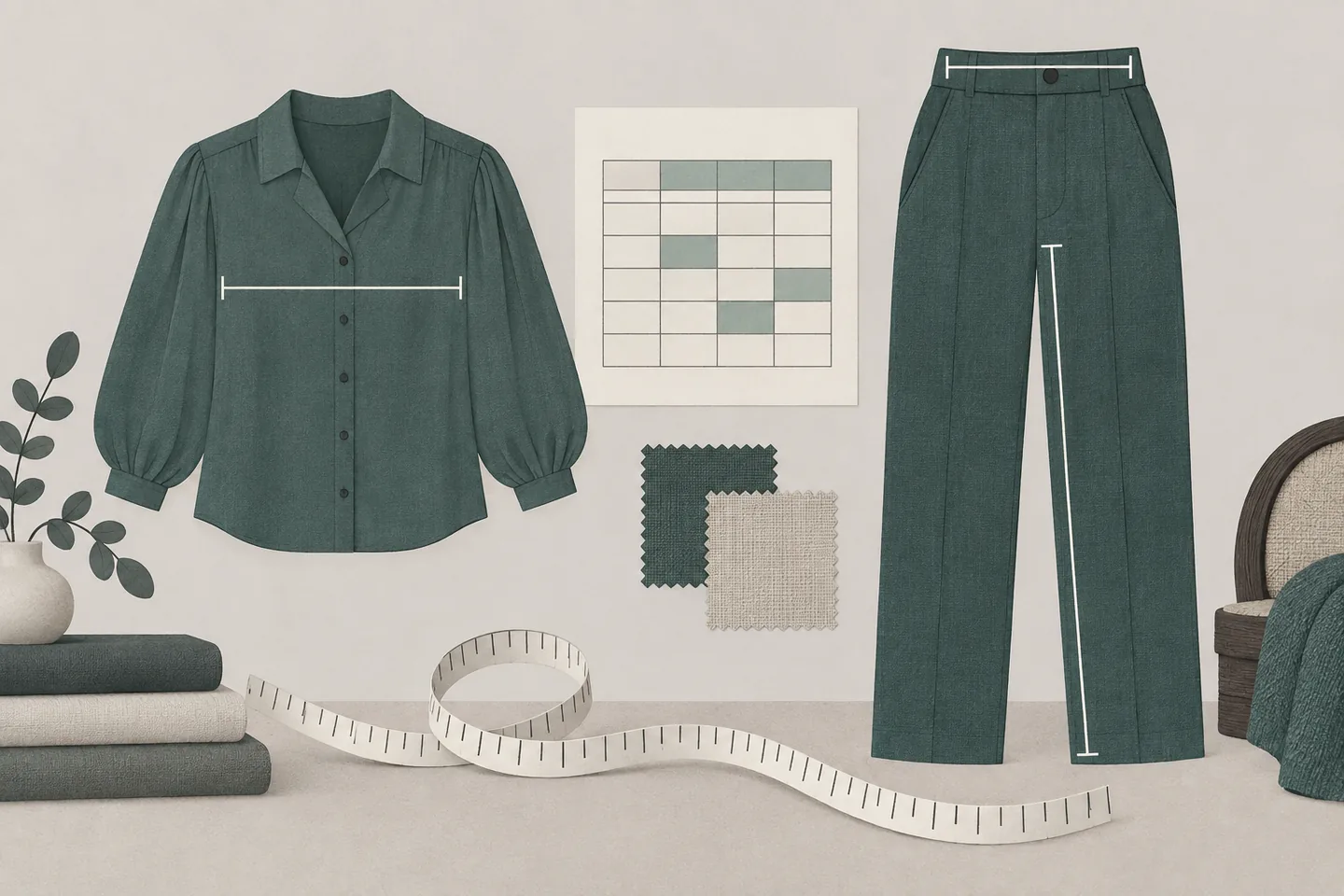
A finished-garment chart describes the clothing itself. A shirt listed with a 42-inch finished bust is 42 inches around at that point when measured as directed. The difference between that number and your bust measurement is its ease. Some charts give a flat width instead: a shirt measuring 21 inches across the chest when laid flat is approximately 42 inches around. Check where the brand says to place the tape before doubling a flat measurement; “chest width” and “hem width” describe different parts of a garment.
Look for headings such as “body measurements,” “garment measurements,” “laid flat,” or “finished dimensions.” Diagrams may show whether the tape goes around a person or across clothing. If the chart gives numbers without a measuring method, ask for one or compare them with a similar garment you own.
Measure the body the chart is asking about
Use a flexible tape over the undergarments you expect to wear with the item. Stand naturally, keep the tape level and close without pulling it tight, and record the units. Measure twice if the tape may have slipped.
- Bust: Measure around the fullest part of the bust, with your arms relaxed. Check that the tape remains horizontal across your back.
- Waist: Measure around your natural waist, typically the crease that appears when you bend gently to one side. A trouser waistband may sit somewhere else, so also note where the particular style is designed to rest.
- Hips: Measure around the fullest part of the hips and seat, keeping the tape level. This point may be lower than you expect; measure where the circumference is greatest.
- Inseam: Measure down the inside leg from the crotch to the length you want the trousers to reach. If doing that on your body is awkward, measure the inseam of trousers whose length you like and note the shoes you wear with them.
These landmarks match Levi’s women’s size guide, which separates waist, hip and inseam instructions for bottoms. When shopping across regions, convert measurement units rather than size labels.
Decide which dimension controls the fit
For a top, begin with the bust or chest, then check the waist and hips where the garment reaches them. A cropped top may not reach the hips; a long, straight woven shirt needs room at its hem. If measurements point to different sizes, consider the cut and fabric at the tighter point. Patagonia advises using chest as the usual predictor for its tops while considering the hip-indicated size when hips are larger. That is guidance for its own chart, not every brand.
For trousers and skirts, compare both waist and hips. The waist controls whether the garment stays comfortably in place; the hip measurement controls whether it can pass over and move around the fullest part of the seat. A fitted trouser needs attention at both points. If they suggest different sizes, favor the dimension that has the least room to adjust in that style, then inspect the other dimension. A waistband that can be altered is a different prospect from a seat that pulls across the hips.
Treat inseam as a separate length decision after checking circumference. Determine whether the number is a body measurement, a finished garment length or a named length option. The preferred hem position may change with your shoes.
Allow for ease, stretch and the intended silhouette
A finished garment usually needs some difference from the body it covers. Wearing ease gives room for ordinary movement; design ease helps create the intended shape. The Sewing & Craft Alliance’s measurement guide explains the distinction and notes that fabrics with little give need more room than knits. More ease is not automatically a better fit: extra fabric in a relaxed shirt may be deliberate, while the same amount in a fitted shirt may change its silhouette.
Subtract your body measurement from the finished garment measurement at the same point. If your bust is 38 inches and the shirt’s finished bust is 42 inches, it has 4 inches of bust ease. That calculation tells you the amount of room, not exactly how the shirt will look: shoulder shape, armholes, fabric weight and where the ease is distributed also matter. Seamwork’s explanation of ease shows how body and finished measurements can be used together and why some stretchy garments have negative ease, meaning they measure smaller than the body before being worn.
Read “slim,” “regular,” “relaxed” or “oversized” as clues to the brand’s intended fit, not as fixed amounts of extra fabric. Stretch also requires more than a fibre label: a fabric must stretch in the direction needed and recover well enough for the design. Do not subtract an arbitrary number of inches from your measurements because a listing says “stretch.” When stretch or fit details are vague, a comparable garment you already wear comfortably is a better reference.
Two hypothetical charts, worked through
Hypothetical woven shirt: Suppose your bust is 38 inches, waist 31 inches and hips 41 inches. A brand’s body chart places all three in size M. Its finished-garment chart gives M a 42-inch bust and 43-inch hem.
That leaves 4 inches at the bust but only 2 inches at the hips. M is a starting point, although the hem deserves closer attention if the shirt buttons below your hips or you prefer a loose drape. Check the larger size’s finished hem before changing sizes.
Hypothetical straight-leg trousers: Suppose your waist is 31 inches, hips 41 inches and preferred inseam 29 inches. A finished-garment chart gives size 8 a 32-inch waist, 42-inch hip and 30-inch inseam; size 10 has a 34-inch waist, 44-inch hip and the same inseam. Size 8 is closer numerically, with an inch of difference at waist and hip.
That narrow margin needs scrutiny. Does the waistband sit where you measured? Is the fabric rigid or stretchy? Is the hip measured at the same level? Ask for product measurements if the answers change the choice. Handle the extra inch of length separately. Neither example is a conversion rule for real brands.
When a brand’s chart is inconsistent
If numbers and descriptions conflict, check the following:
- Confirm the chart’s scope. Is it for this product, this category, or the brand as a whole? Use the product-specific chart when its measuring instructions are clear.
- Confirm the units and measurement type. Inches and centimetres can sit on adjacent tabs. A flat width should not be compared directly with a body circumference.
- Check the controlling points. For the actual garment, identify the bust, waist, hip or inseam that could prevent it from fitting as intended.
- Compare a known garment. Measure a similar item you own at the same points, using the same flat or circumference method. Its fit on you gives the numbers context.
- Pause when the missing detail changes the choice. If one chart calls a number a body waist and another calls it a garment waist, or the stated fit contradicts the dimensions, request a product measurement rather than guessing.
A final return-risk check
Before ordering, save the product-specific chart and measurements you relied on in case the item arrives differently than expected. Read the seller’s actual return terms for that item and location; a size chart cannot establish whether a return qualifies or what it might cost.
For a Finnish-language clothing catalogue, https://www.hersecret.fi is one place to apply this comparison. Check whether the garment page gives body or garment measurements before relying on the size label.