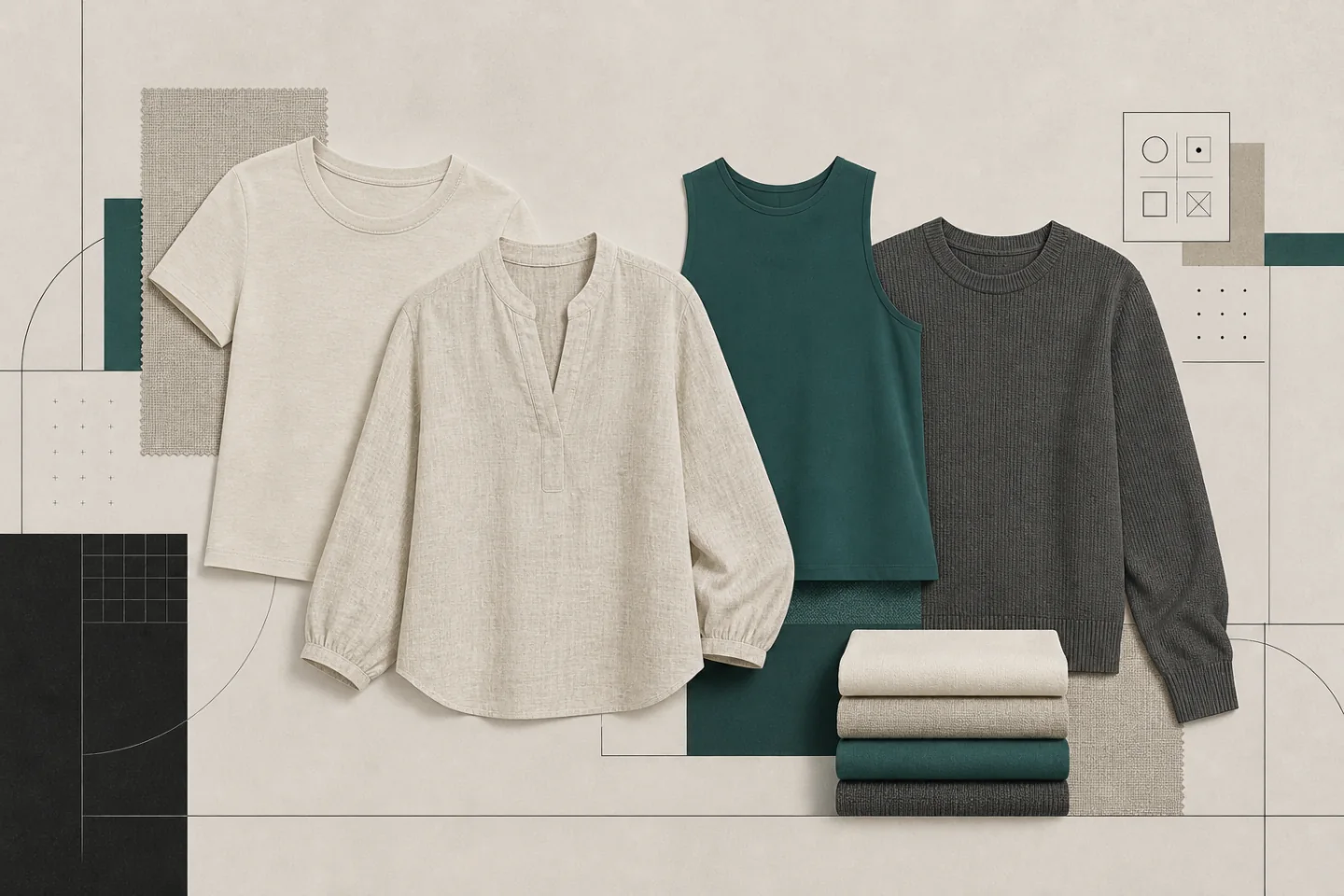
James Andean · women’s wholesale wear
Women’s Tops

By Ruth Keller
A useful top should feel comfortable, sit well with the rest of an outfit and suit the way it will be worn. Labels such as fitted, relaxed or oversized help, but they do not tell the whole story. Fabric weight, shoulder placement, hem length and care needs can make two apparently similar tops behave very differently.
The simplest way to choose well is to start with purpose. Decide whether the top needs to work alone, beneath a jacket, across changing temperatures or for repeated everyday wear. Then assess fit and fabric in that context rather than treating size or colour as the only decision.
Start with fit and movement
A top fits well when it allows ordinary movement without constant adjustment. Raise both arms, reach forwards and sit down. The neckline should stay where expected, the shoulder seams should not pull, and the hem should provide the intended coverage. On a buttoned shirt, the front should lie flat rather than strain between buttons.
Check the fit at the shoulders first. On a set-in sleeve, the seam usually looks neat when it meets the outer edge of the shoulder. A seam placed farther down creates a deliberately relaxed shape, but too much fabric can restrict layering and bunch beneath a coat. Raglan and dropped sleeves have different seam positions, so judge them by comfort and drape instead.
A fitted top follows the body and makes a practical base layer. A semi-fitted cut skims without clinging and moves easily between casual and smarter outfits. Boxy and oversized cuts provide more room, although their width may need balancing with a defined waist, a shorter hem or straighter bottoms.
Choose a useful length
Consider the rise of the trousers or skirt you wear most often. A hem near the high hip usually tucks into mid- or high-rise bottoms without much bulk. A longer top can work untucked or provide coverage with close-fitting bottoms. Side splits give the hips more room and help a longer hem fall cleanly.
If you plan to tuck the top, gather a small section of fabric at the waist. Thick bunching suggests it may sit better untucked or with only the front tucked in. Also check the back while seated: a top that appears long enough when standing may ride up during normal movement.
Read the fabric, not just the fibre label
Fibre content affects feel and care, but construction and weight matter too. A dense cotton jersey can hold a clean outline, while a fine cotton knit may cling or become slightly transparent when stretched. Hold the fabric up to the light, stretch it gently and let go. It should provide the coverage you want and return close to its original shape.
Cotton is widely used for T-shirts and shirts because it feels comfortable and is generally straightforward to wash. It can crease and may retain moisture. Linen allows air to circulate and suits warm conditions, but its natural creasing is part of its appearance. A cotton-linen blend often provides a middle ground between softness, airflow and easier care.
Viscose and modal usually have a fluid drape and smooth feel. They can suit blouses and close base layers, although some versions need gentle washing and careful reshaping. Wool can provide warmth without requiring a heavy layer, but its washing instructions vary. Synthetic fibres may add durability, shape retention or quicker drying.
Check stretch and recovery
Stretch is particularly helpful across the shoulders, bust and upper arms. Gently extend a small area, then release it. Fabric that remains rippled or loose may lose its shape with wear. For a close-fitting top, also bend the elbows and reach forwards to make sure movement does not pull the neckline or hem out of place.
Match the neckline and sleeves to the task
Crew necks create a simple, higher line and layer neatly beneath many jumpers. V-necks and scoop necks leave more space around the neck, while square necks create a more defined edge. Try the neckline while bending and sitting, especially if the top is intended for work or travel. A decorative neckline is less useful if it needs frequent repositioning.
Sleeves should allow the arms to move without twisting the body of the top. Short sleeves can be close or loose, but the opening should not pinch. Long sleeves should reach the intended point without heavy bunching at the wrist. If the top will sit under a blazer or cardigan, smooth, moderately fitted sleeves usually layer more easily than wide or textured ones.
For sleeveless tops, inspect the armholes from the front and side. They should provide the coverage you want without cutting into the skin. Strap width, neckline depth and undergarment placement are worth checking together rather than after purchase.
Build around a few distinct roles
A practical wardrobe does not need many near-identical tops. It benefits more from pieces with clear jobs. Before adding one, ask which outfit or situation it improves and whether that role is already covered.
- Everyday base: a comfortable T-shirt or fine long-sleeved top that works alone and under another layer.
- Structured option: a shirt or firmer knit that pairs with tailored trousers, skirts or dark denim.
- Warm-weather layer: a breathable sleeveless top or loose shirt with secure armholes and suitable opacity.
- Flexible smarter piece: a simple blouse or refined knit without details that limit how it can be styled.
Neutral shades are useful when they connect to clothes you already own, but neutral does not have to mean black or white. Navy, cream, grey, brown and muted colour can all form a base. Test a possible purchase against at least three existing bottoms or layers. This reveals whether it fills a genuine gap or depends on further shopping.
Use outfit balance as a guide
When a top has volume, a cleaner line below often keeps the outfit readable. A boxy shirt can pair with straight trousers; a loose blouse can be tucked partly or fully to show the waist. With wide trousers or a full skirt, a closer or shorter top may provide contrast.
Texture can create interest without making an outfit difficult to repeat. Ribbed knits, crisp woven cotton and fluid fabrics each give a different effect even in similar colours. If several pieces compete through volume, print and texture, simplify one element. For easy layering, place thinner, smoother fabric closest to the body and leave enough room in the outer layer for the sleeves and shoulders.
Assess quality before keeping a top
Look along the seams for skipped stitches, loose threads and puckering. Seams should feel secure without twisting the garment. Check that patterns align where this is visually important, that buttons sit firmly and that buttonholes are neatly finished. On knits, inspect the neckline, cuffs and hem for stretching or uneven ripples.
Try the top with the underwear and layers you expect to wear. Natural and indoor lighting can reveal transparency that a fitting room hides. If ordering remotely, compare the garment measurements with a top you already own rather than relying only on a general size label. Bust width, shoulder width, total length and sleeve length are the most useful comparisons.
Comfort during a brief fitting can be misleading. Keep the top on long enough to sit, reach and move. Scratchy seams, slipping straps and a hem that continually rises are unlikely to improve through styling.
Wash and store tops carefully
Follow the care label because garments with similar appearances may use different fibres, dyes or finishes. Wash only when needed, separate colours where dye transfer is possible and treat marks promptly according to the fabric instructions. Turning printed or embellished tops inside out can reduce surface friction.
High heat can shrink fibres, weaken stretch and set some stains. Use the recommended temperature and avoid a tumble dryer when the label advises air drying. Reshape knits while damp and dry them flat so their weight does not pull them longer. Woven shirts can usually dry on a suitable hanger if the shoulder area is supported.
Store heavy or stretchy knitwear folded. Hanging can distort the shoulders and length over time. Lighter woven tops may be hung with enough space to prevent crushing. Keep clothing dry and away from prolonged direct sunlight, which can fade colour. Airing a lightly worn top may postpone an unnecessary wash, reducing wear on both the fabric and its finish.
Make small repairs early
A loose button, opening seam or dropped hem is easier to repair before the damage spreads. Keep spare buttons with the garment or in a labelled container. Remove pills only with a method suited to the fabric, working gently to avoid thinning the surface. When a top no longer suits its original role, it may still work as a base layer, home garment or repair project.